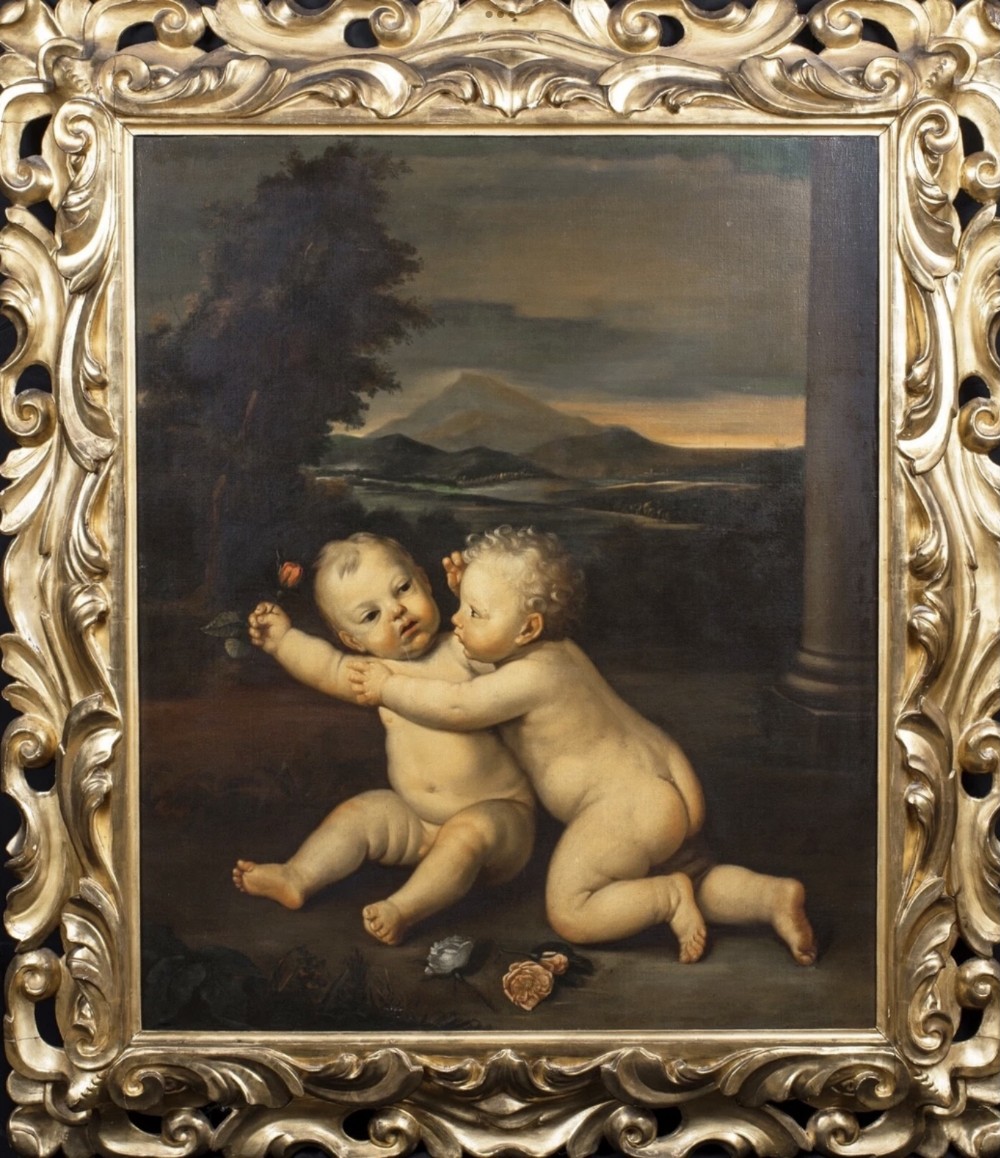

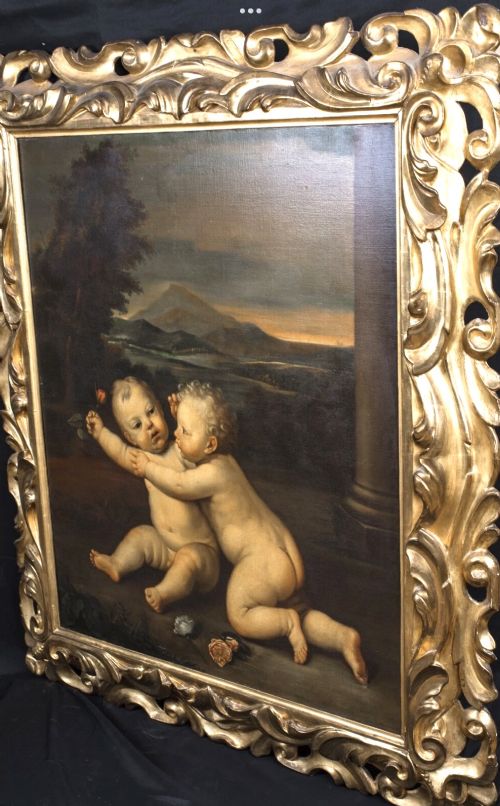
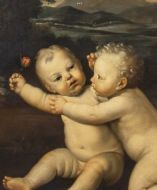

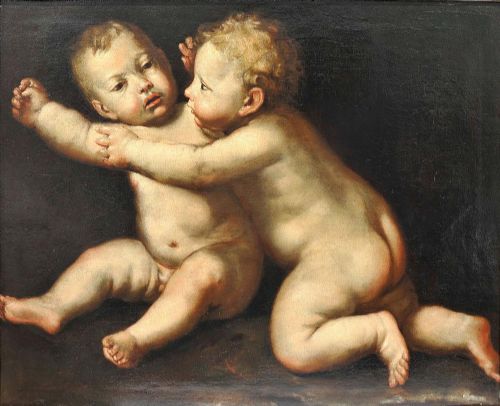


Huge 19th Cherub Painting Children Sitting Holding Rose Rudolphine School Putti Baroque Portraits After Domenico Zampieri 1581–1641
Price
£15,000
| $20,377 USD | €17,180 EUR
Item Ref
0952
Description
Early 19th-century paintings often highlighted by auction houses as "Rudolphine school" refer to artworks inspired by the 17th-century Prague court of Rudolf II, frequently featuring detailed allegories, mythological scenes, cherub putti or still life's with rich, dramatic chiaroscuro.-
These works, are a romanticised, 19th-century academic reinterpretation of Baroque putti themes, often mistaken for later, are characterised by intense, detailed, and often dark, Mannerist-influenced compositions.
-
ARTIST STYLE
‘ After ‘ Domenico Zampieri/Domenichino): Domenico Zampieri (1581–1641) was a Bolognese Baroque painter known for his classically inspired, balanced compositions.
A 19th-century work "after" him would likely emulate his style of soft, idealised figures.
-
RUDOLPHINE SCHOOL
While "Rudolphine" usually refers to the late 16th/early 17th-century artists at the court of Rudolf II in Prague (e.g., Hans von Aachen), in a 19th-century context, it may refer to a revivalist or academic school, often blending Baroque themes with Romantic sentimentality.
-
19th Century Copy/Style: Paintings created "after" old masters (like Domenichino) were common in the 19th century as part of academic training or to satisfy demand for decorative, Old Master-style art.
-
Based on 17th-century art, a painting of a putto sitting and holding a rose typically represents an allegory of love, fleeting beauty, or innocence, often associated with the goddess Venus or, in religious contexts, the Virgin Mary
-
EXAMPLES
17th Century, Emilian School, Putto With Rose: Often specifically oil on canvas showing sitting putto squeezing a flower (rose or peony) while looking at the viewer.
Often featuring a soft, light-filled style typical of the Emilian school.
-
17th-century, Italian School, Still Life with Putti: A Roman 17th-century oil painting, sometimes found in pairs or sets, depicts putti alongside flowers and fruit.
-
Carlo Innocenzo Carloni, Putti Holding Flowers: While some of his work extends into the 18th century, Carloni’s style of putti, often sitting or reclining among roses and flowers, reflects the late Baroque/early Rococo transition.
-
Workshop of Rubens, Putti with Flowers: Rubens frequently used putti in his commissions, often as part of larger, triumphant allegories.
-
SYMBOLISM &STYLE
The Rose: Symbolises the fleeting nature of love and the joy it brings, or in Christian art, the "Rosa senza spine" (rose without thorns) representing the Virgin.
-
PUTTI CHARACTERISTICS
In this period, putti are often depicted with soft, chubby, amber-skinned bodies, frequently set against a soft or dark, atmospheric background.
-
ALLEGORY OF SUMMER
In some, particularly northern European, examples, putti holding flowers or sitting among foliage are used to represent the season of summer or spring.
-
INSCRIPTION
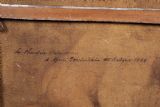
A penned inscription says “ after “ artist Domenico Zampieri 1849.
-
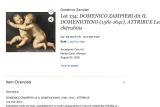
SAMPLE IMAGE / FROM AUCTION LISTING
Small 17th Example of the same Cherubs
attributed to Domenico Zampieri, stating a pre cartoon of a work or cut down piece from a much larger scale work , perhaps no longer
in existence.
-
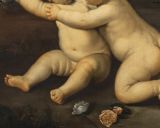
Our example is finished with rose in hand and has flowers painted in the foreground placed within a full landscape with stone pillar to the right margin providing scale, having a sunset and mountainous terrain beyond with sky.
-
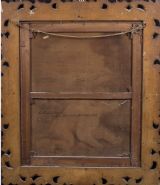
FRAME : Presented in an early 19th century Venetian Gilt Carved Frame of Italian origin.
-
DELIVERY : UK By Specialist Art Courier £150
Worldwide : EU £1000 / USA £1200
-
TELEPHONE Enquiries : 07765 856171
Payments are accepted by Bank Transfer & by Debit / Credit Cards Via the BUY NOW Payment Link Tab shown below each items description.
PAY-PAL Account Holders are welcome. CHEQUES Drawn from UK banks.
Internal Ref: 0952
Dimensions
Height = 152.5 cm (60")Width = 134.5 cm (53")
Depth = 5 cm (2")
We accept online payments for this item:
BUY NOW with CREDIT CARD or PAYPAL
Email about this item:

SEND EMAIL